
© CARTO © OpenStreetMap
Polyrhythm - Constructive simulation engine
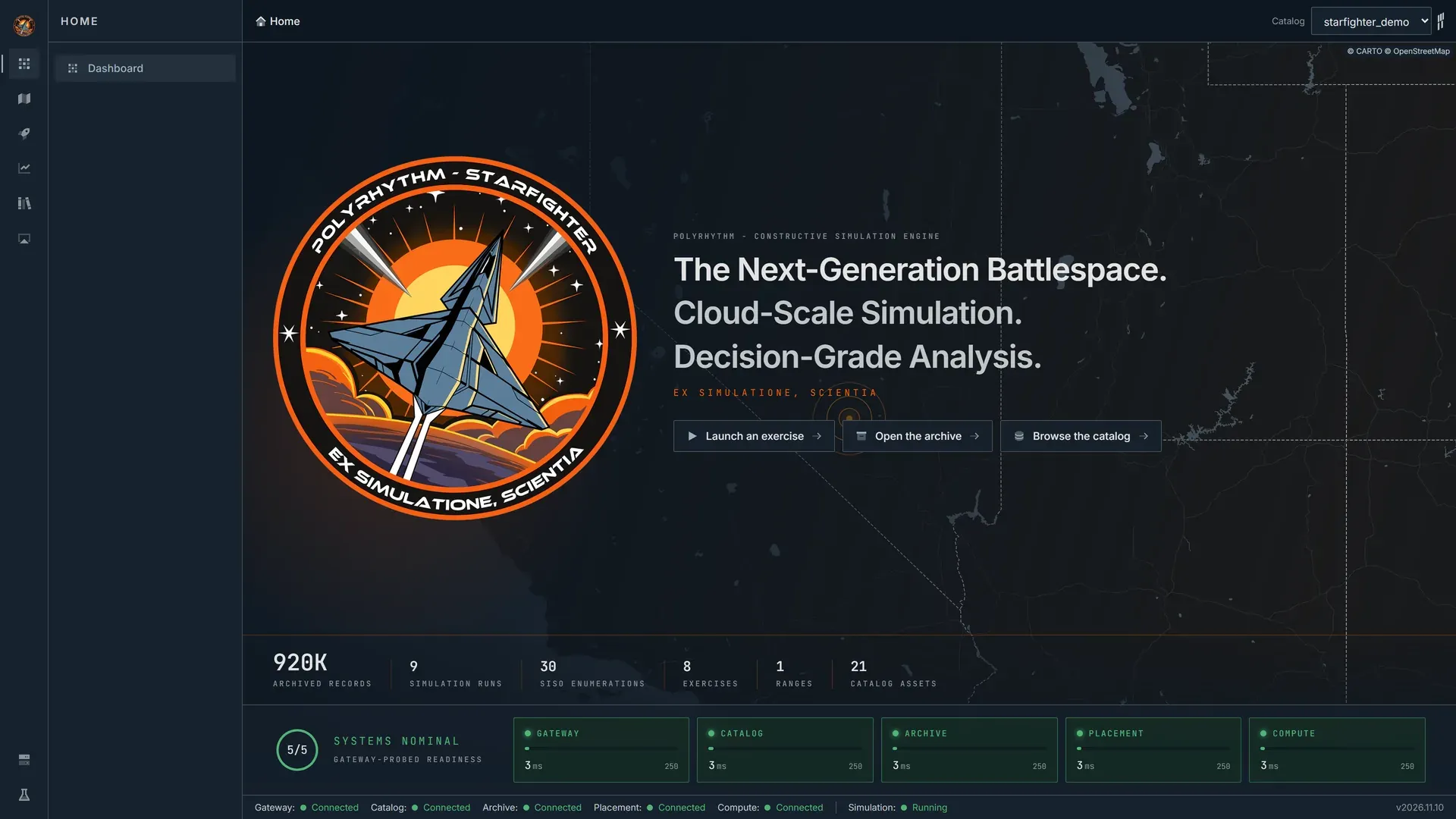
Starfighter™: The Next-Generation Battlespace.
Cloud-Scale Simulation.
Decision-Grade Analysis.
Ex Simulatione, Scientia
- AFSIM integration
- Monte Carlo & DOE
- Execution evidence
- Live · Virtual · Constructive
Experience, built into the architecture.
Decades of modeling and simulation, weapons systems analysis, and live-virtual-constructive research and application come together in Starfighter™. Shaped by the people who build, connect, and use simulation to answer demanding mission questions.
Starfighter's full-native functionality is available over HTTPS, including building scenarios, integrating models, running studies, and reviewing results and supporting evidence.
Modeling & simulation
Model the mission.
Bring platforms, sensors, and weapons into a shared simulation environment. Explore how systems behave together and how changing one assumption can change the outcome.
Weapons systems analysis
Put decisions to the test.
Compare concepts, examine tradeoffs, and return to the evidence behind a result. Keep the analyst's question at the center of the simulation.
Live · Virtual · Constructive
Built with integration in mind.
Experience across live, virtual, and constructive environments informs the architecture. Bring your models, your mission context, and the lessons of the range into the next generation of simulation.
One environment, from scenario to evidence.
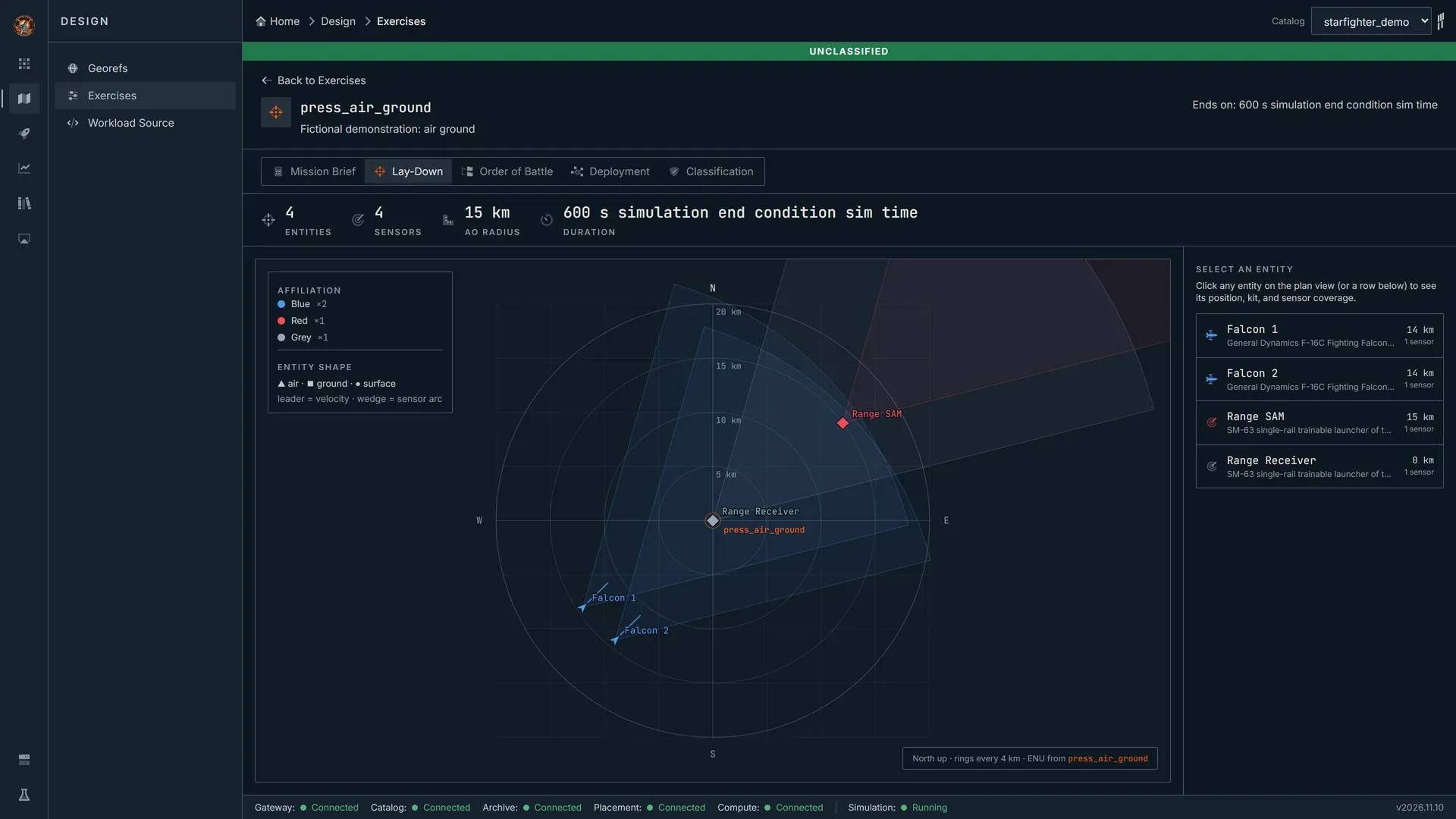
Starfighter is built for the way modern analysis works: distributed, reproducible, and accountable from the first scenario to the final answer. The views below show fictional demonstration activity.
© CARTO © OpenStreetMap
© Cesium ion © Esri, Maxar, Earthstar Geographics, and the GIS User Community
Overview
Step 01, Overview: Built cloud-native from the start.
Starfighter was designed as a distributed platform, not a desktop simulation retrofitted for the cloud. The entire environment, from data to compute, is one system, open from any browser.
Composition
Step 02, Composition: One source of truth for the battlespace.
Platforms, sensors, and weapons are defined once, in standard terms, and shared by every integrated model. Every analyst starts from common ground instead of a private copy.
Launch
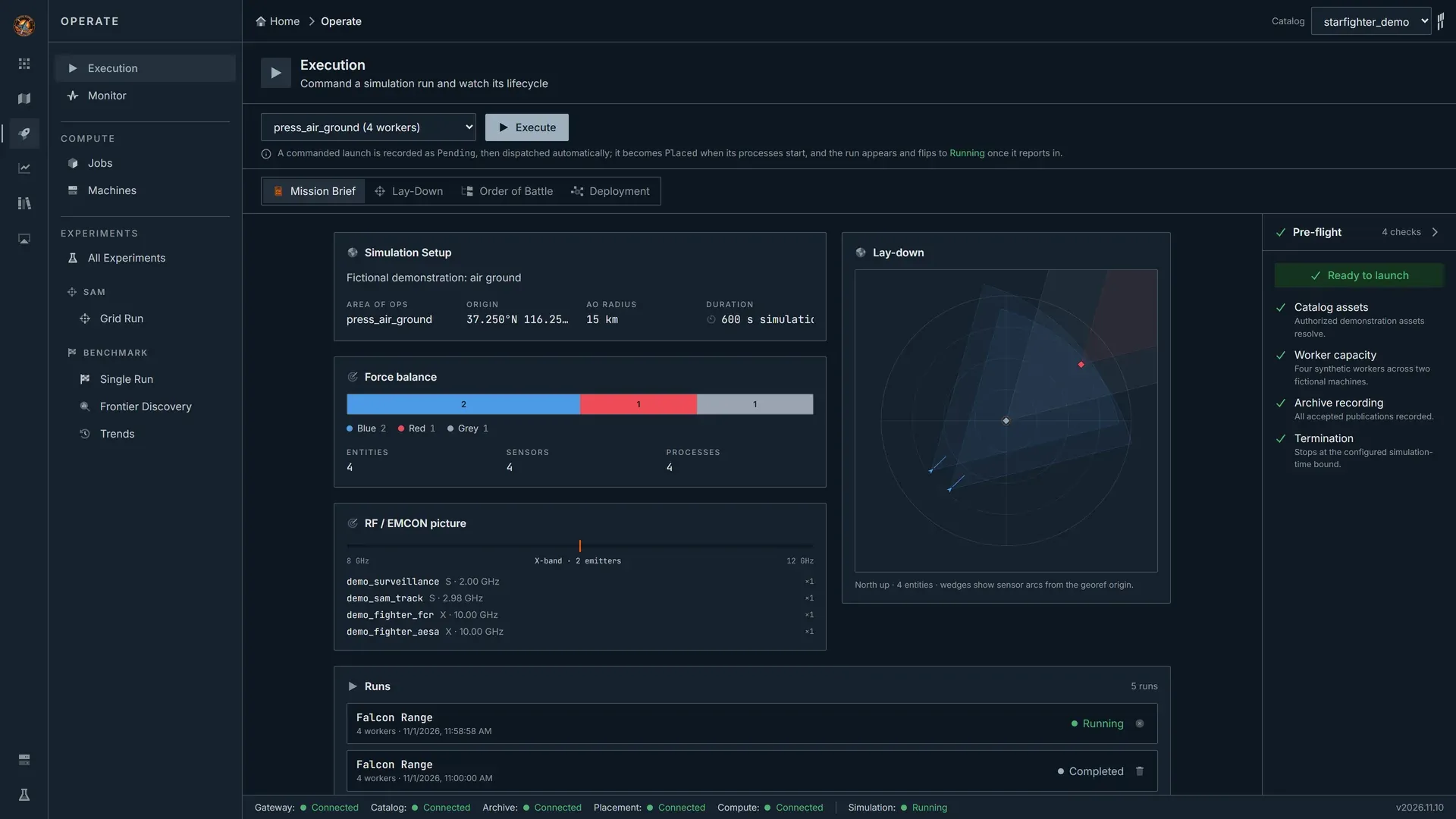
Step 03, Launch: Reproducible by design.
At launch, Starfighter freezes everything a run depends on. Every result stays tied to exactly the inputs that produced it, whatever changes afterward.
Execution
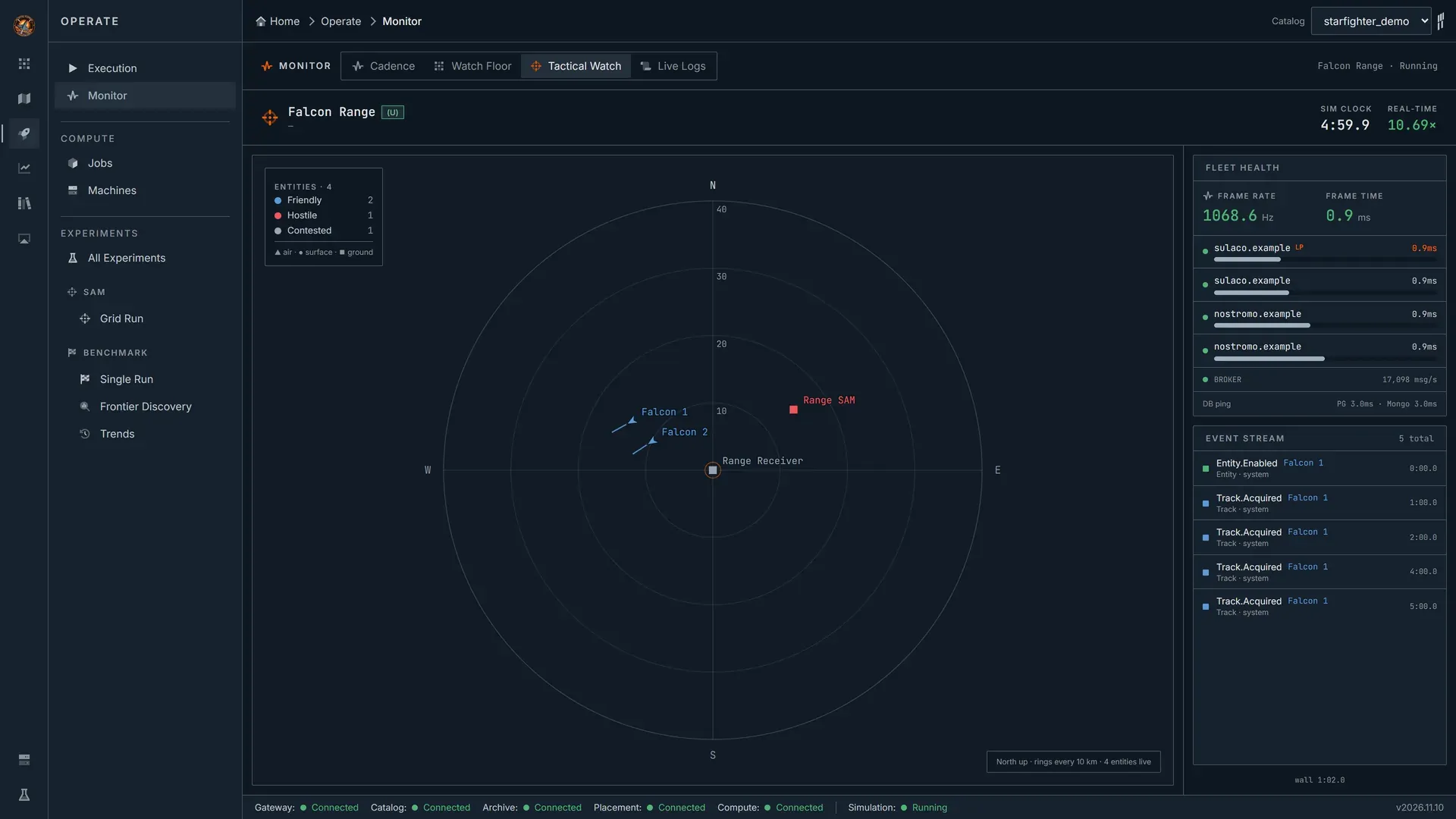
Step 04, Execution: Scale out, not up.
Simulation runs as coordinated workers across available compute, not on one oversized machine. Watch the battlespace and the fleet together as the run unfolds.
Experiments
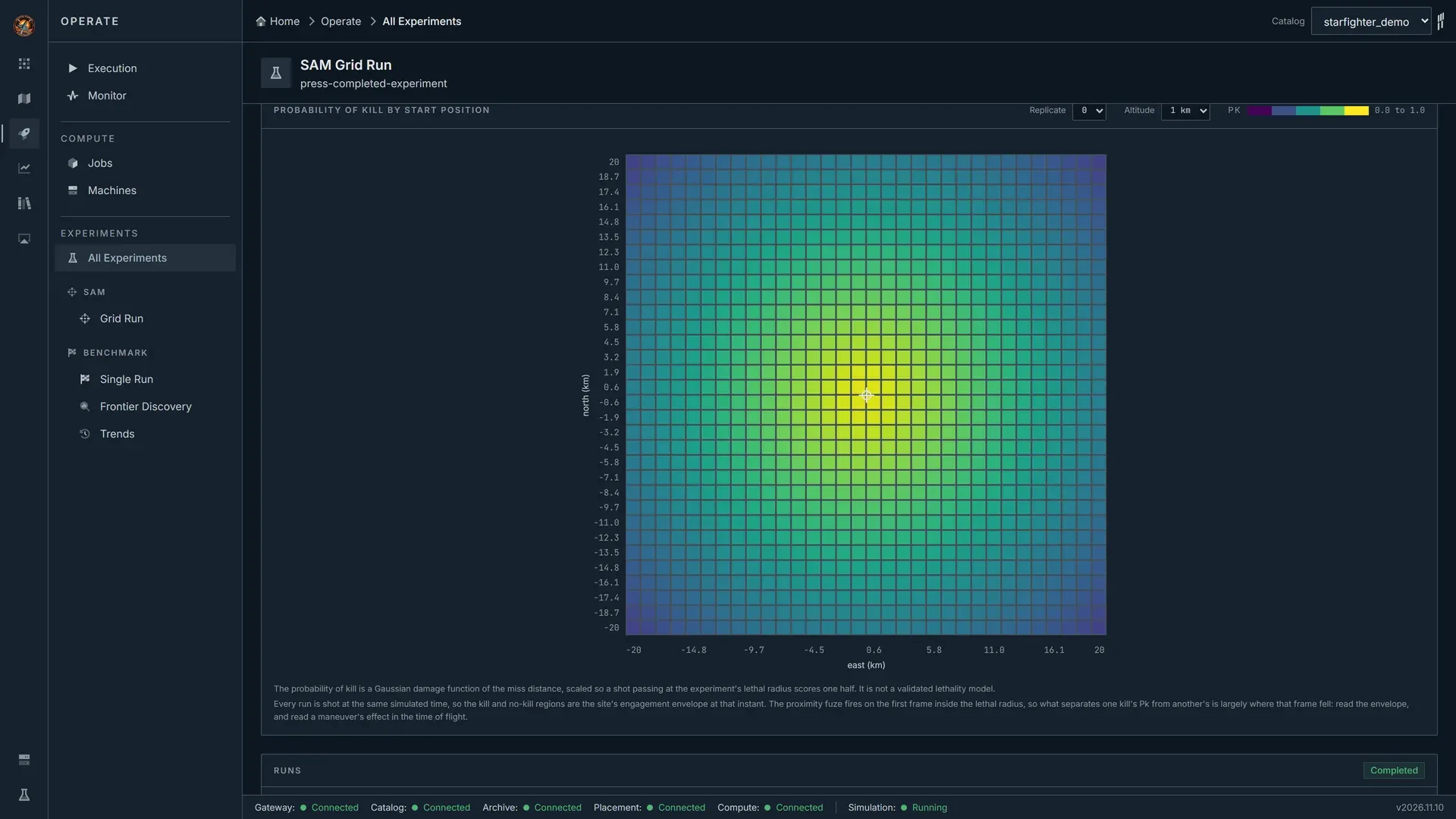
Step 05, Experiments: For solutions, not just scenarios.
Define the question once and Starfighter commands every run it takes to answer it. The answer comes back as a picture of the decision space, not a single data point.
Analysis
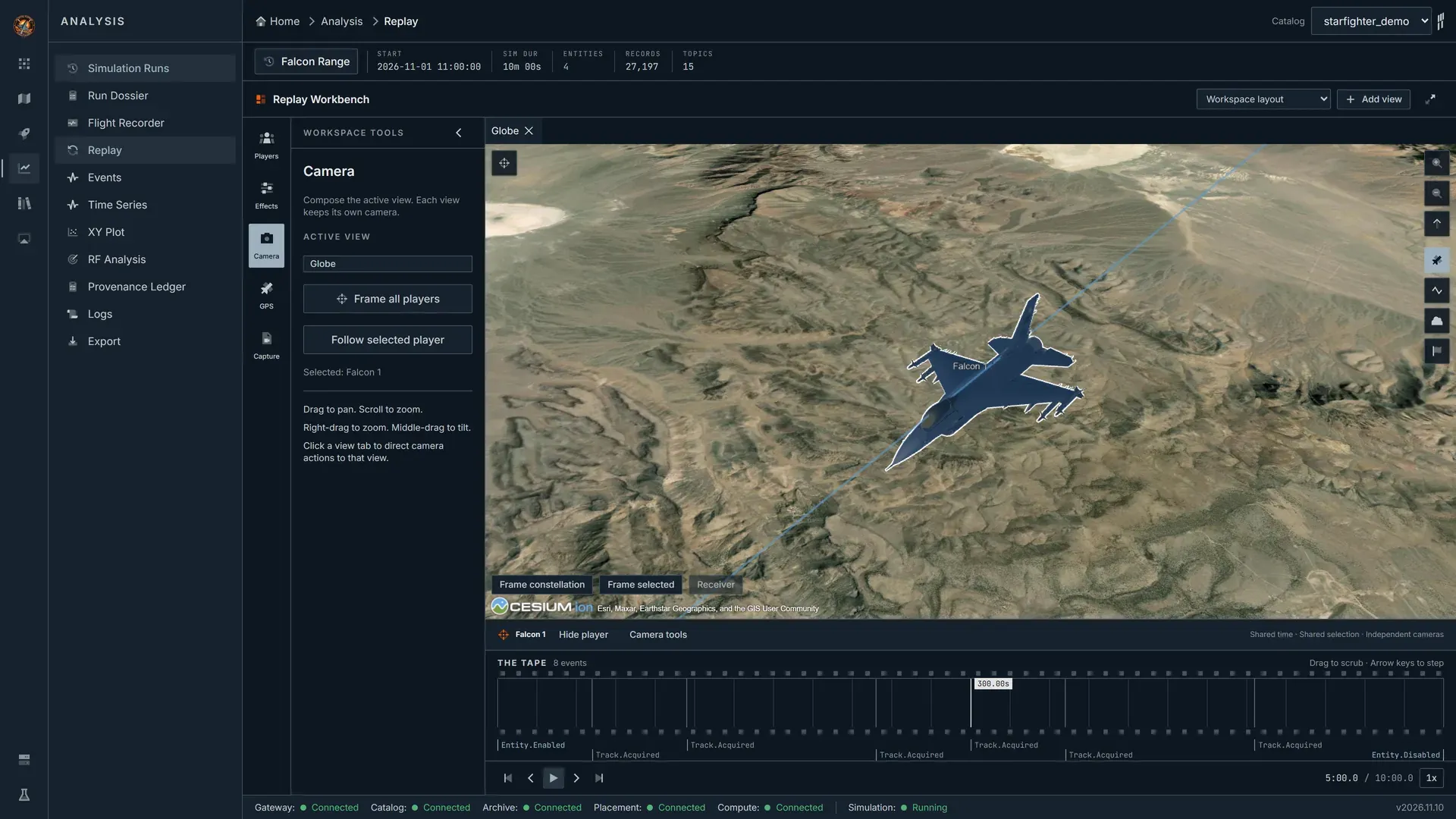
Step 06, Analysis: Every moment, on the record.
Every run is captured in full. Revisit any moment, every event, from any perspective.
Analysis
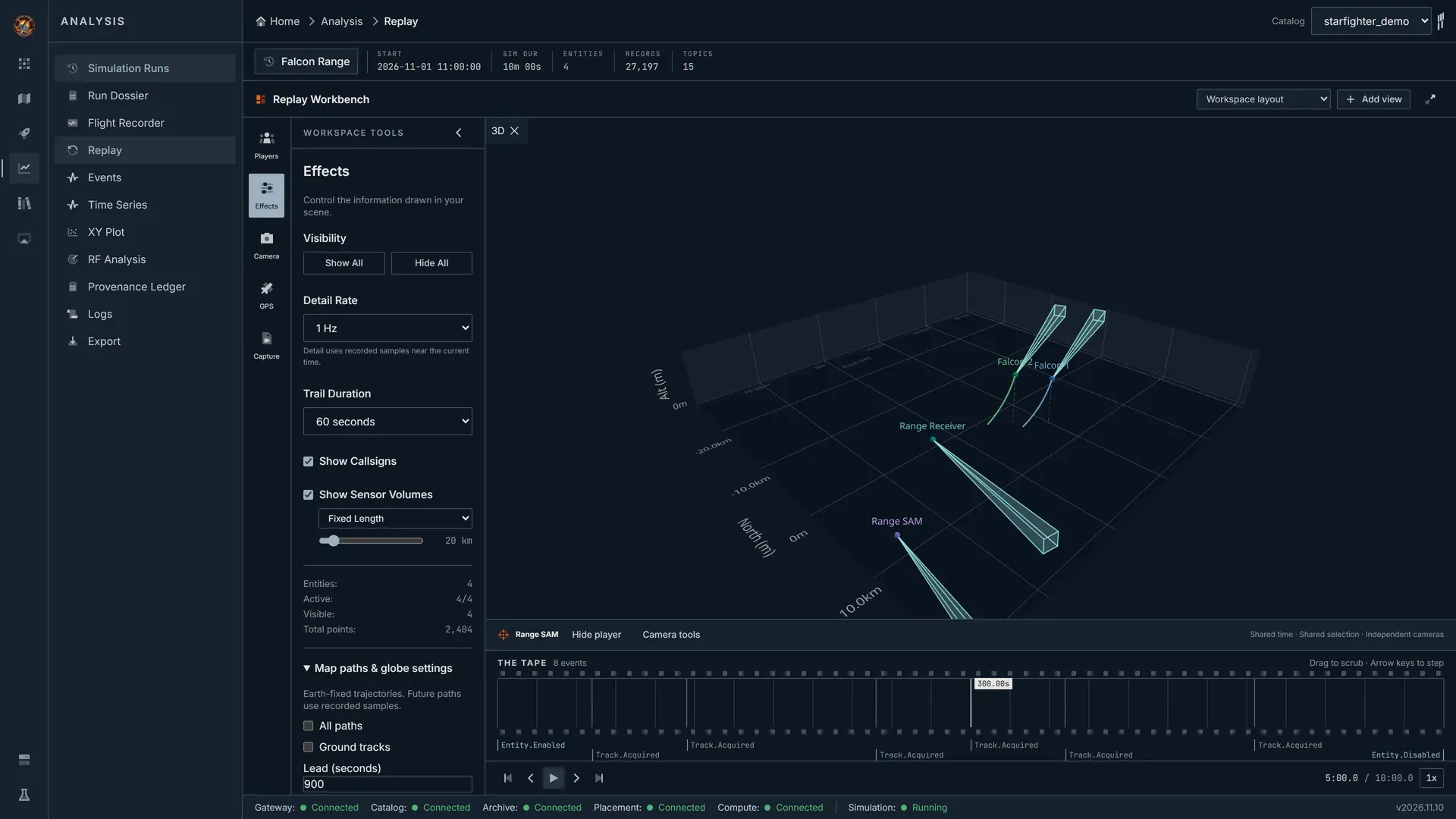
Step 06, Analysis: See why, not just what.
Sensor geometry and entity motion come back together in 3D, so the conditions behind an outcome are visible, not inferred.
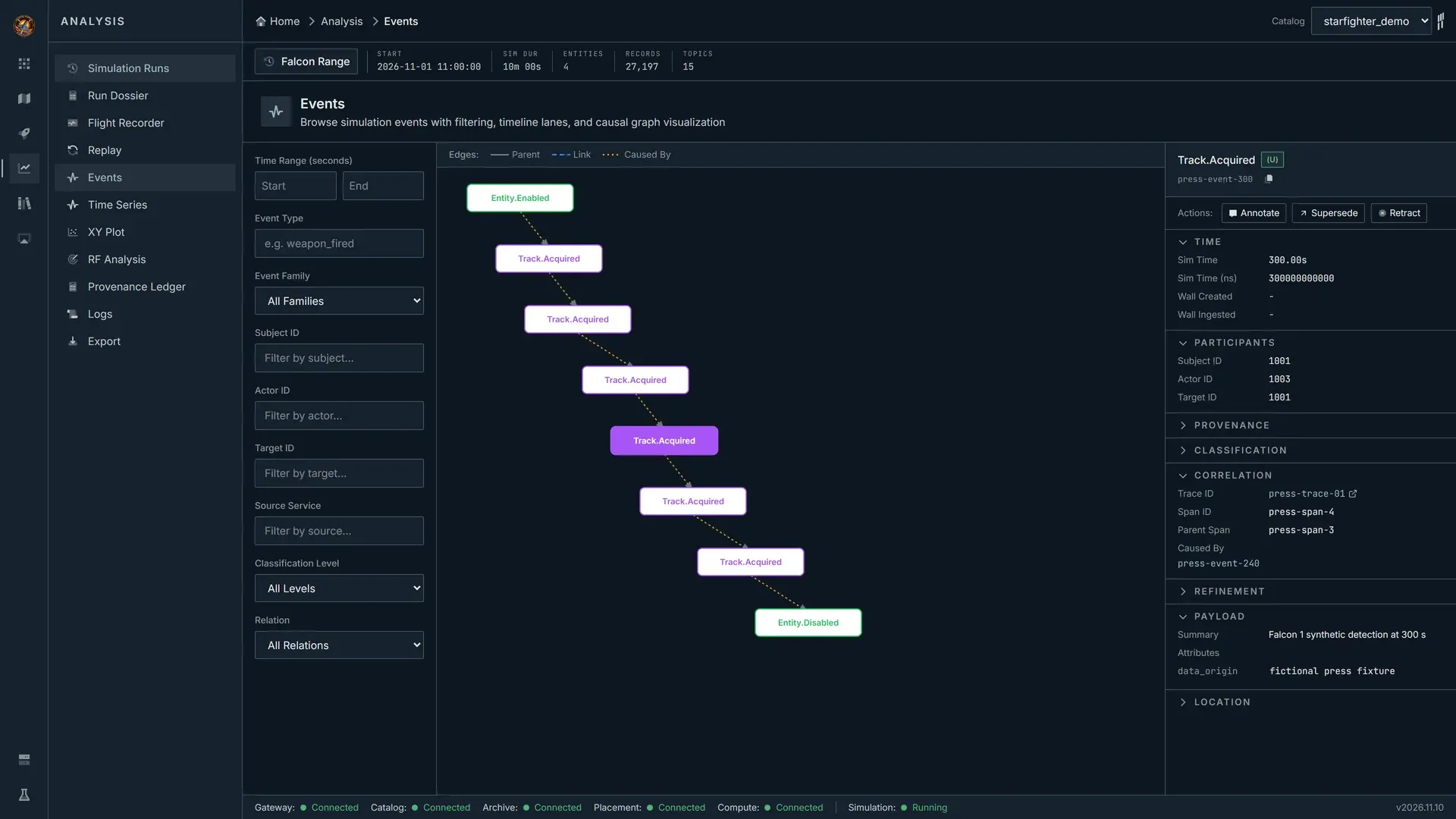
Analysis
Step 06, Analysis: Cause and effect, connected.
Events stay linked to what caused them. A surprising result becomes a trail you can follow.
Engineering
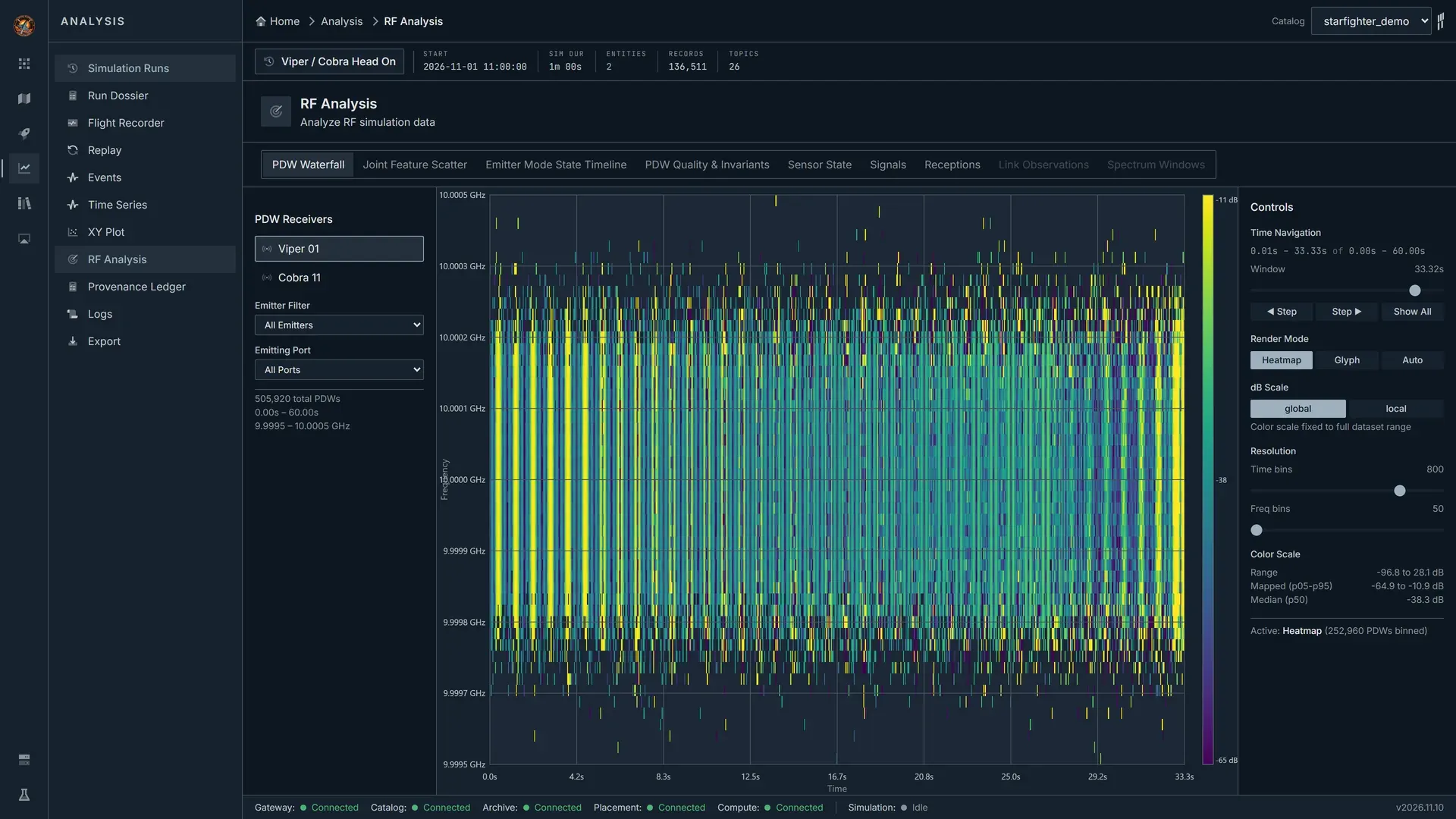
Step 07, Engineering: Dig into detailed engineering data.
Mission-level questions and engineering-level detail live in the same run. Go from an engagement outcome down to the individual radar pulses behind it.
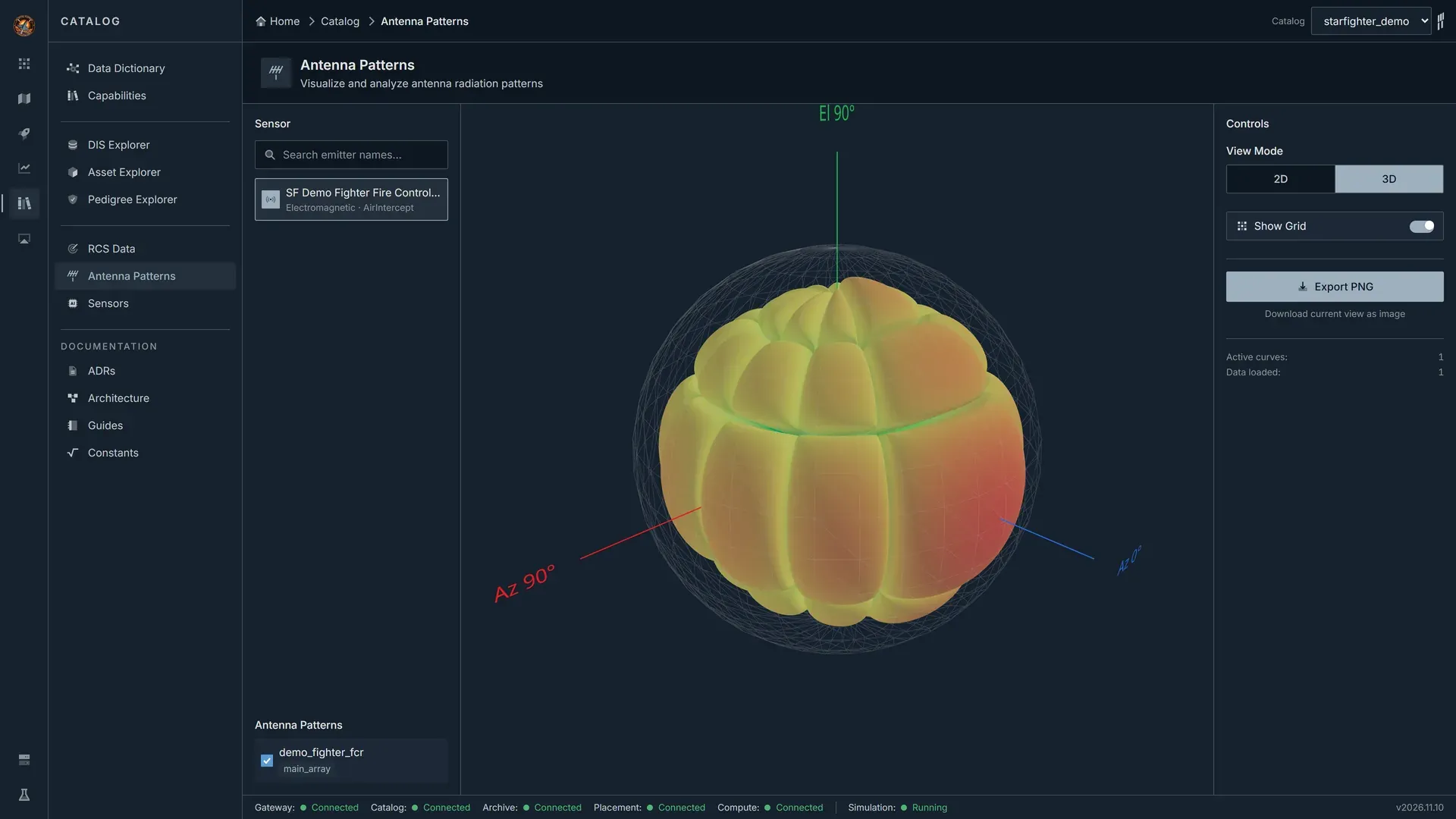
Engineering
Step 07, Engineering: Know what the models stand on.
The engineering data behind every sensor is open for inspection. Confidence in a model comes from seeing it, not assuming it.
Evidence
Step 08, Evidence: Results you can defend.
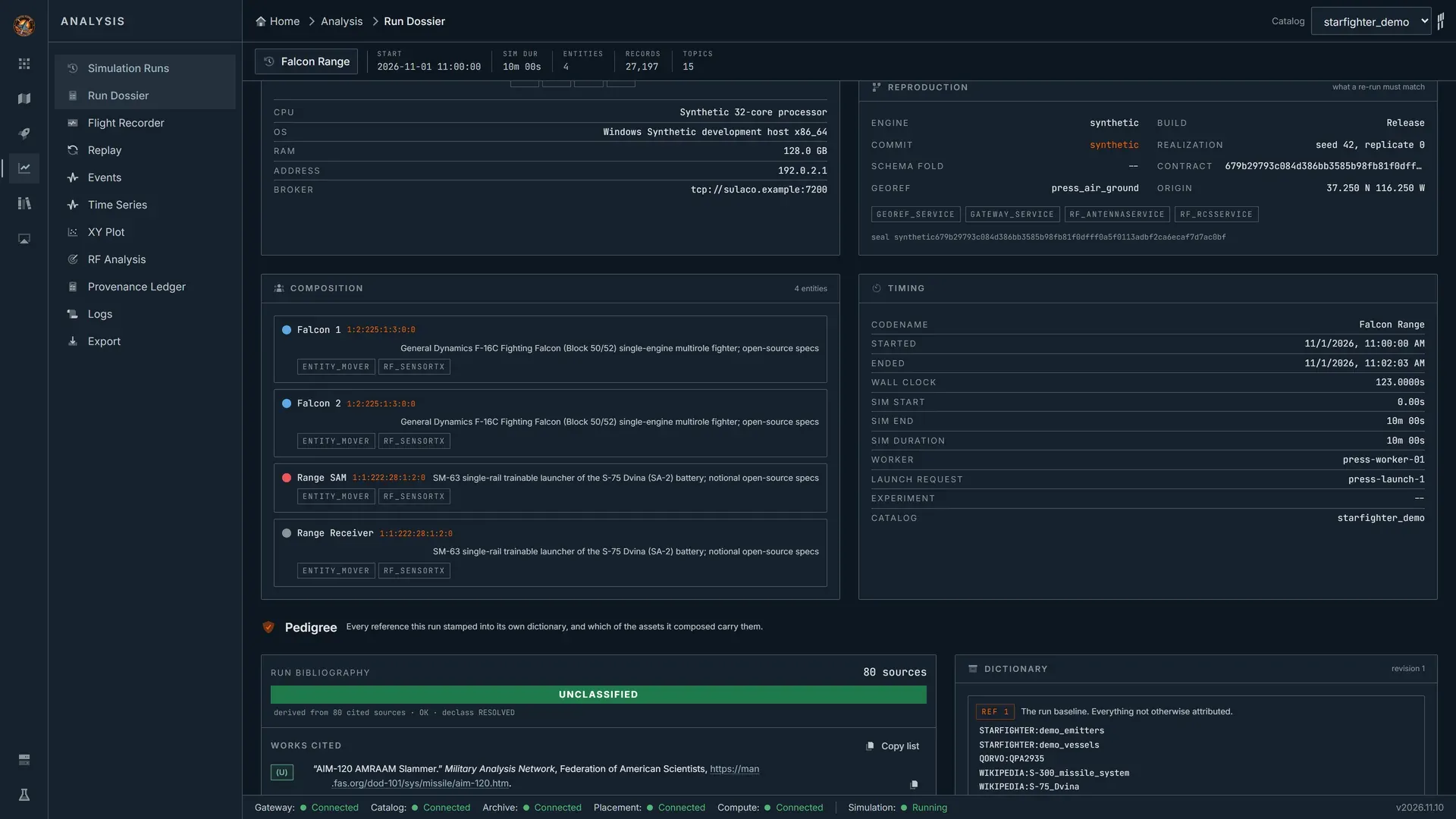
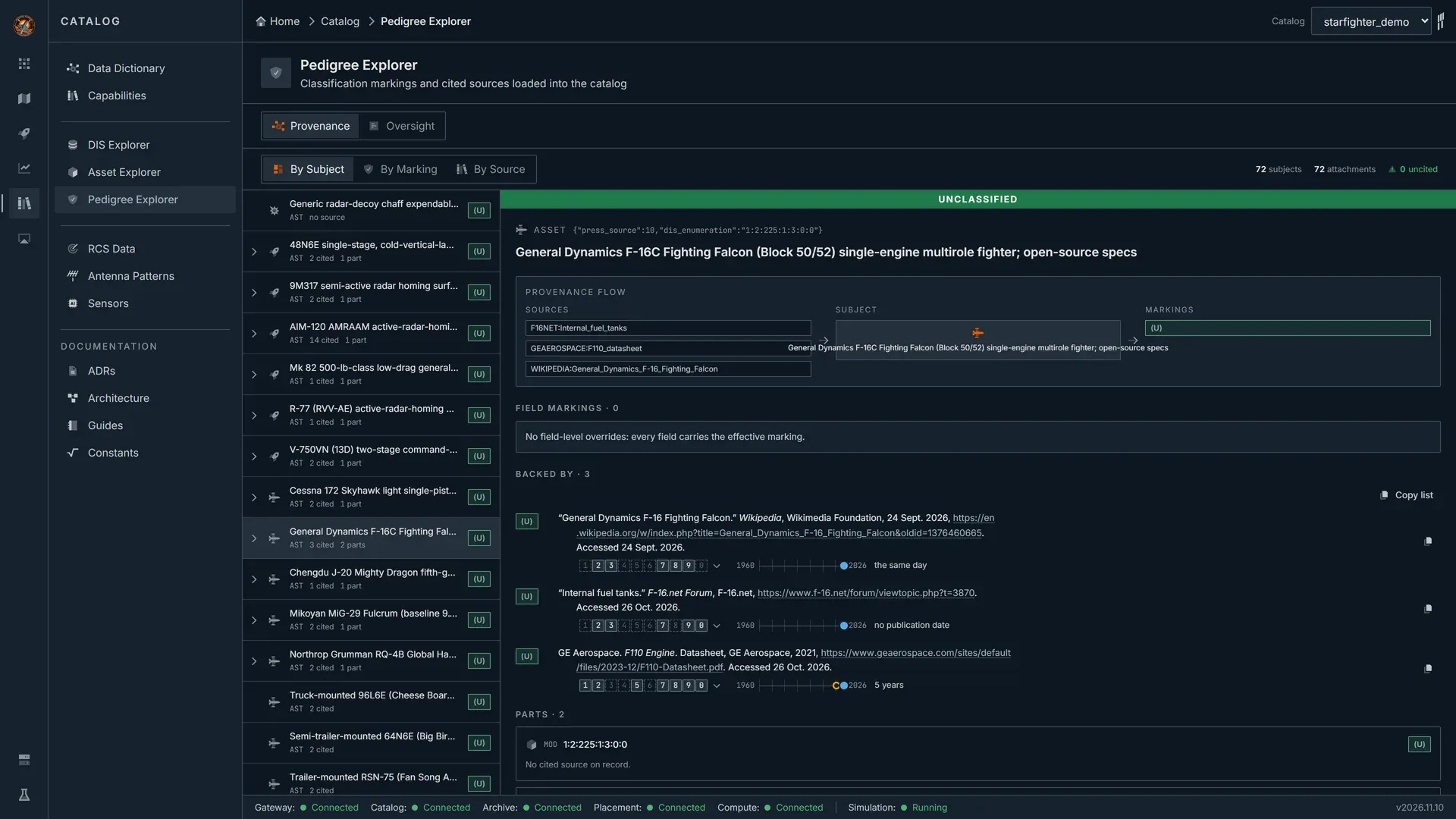
Every run carries its own provenance: every source document, intel report, and its classification is tracked through the entire ecosystem. When a result is challenged, the evidence is already there.
Evidence
Step 08, Evidence: Security and sources, built in.
Classification markings and source citations travel with the data into every run. Review is part of the workflow, not an afterthought.
Drag the tape or use the arrow keys. Page Up and Page Down move between steps. Product view · Illustrative data
Keep the model. Modernize the environment.
Established simulation models carry years of engineering judgment, test history, and analyst confidence. Rewriting them to fit a new architecture spends that investment and restarts the evidence trail. Starfighter™ brings existing models into a modern, scalable, interoperable computing environment, usually with little or no change to the model itself.
This is not new ground. The engineers behind Starfighter™ have spent their careers connecting simulations that were never designed to work together, and have helped shape the practices the simulation community uses to integrate and reuse models.
-
Preserve
Integrate, don't rewrite.
Existing models connect at the interfaces they already have. The model stays largely unchanged, so its pedigree, test history, and known limitations remain traceable.
-
Connect
Make the seams explicit.
Interoperability depends on agreed state, timing, and data meaning at every boundary. Integration makes those terms explicit, so legacy and newer models can share one scenario.
-
Scale
Run beyond the original hardware.
Once integrated, a legacy model runs alongside the rest of the environment across distributed compute. Analysis is no longer bounded by the machine the model was built for.
More possibilities. A wider field of view.
Distribute simulation across compute resources and execute independent runs in parallel. Run experiments across changing conditions, explore more of the decision space, and keep the evidence connected. Starfighter™ is built to scale with the questions you need to ask.
Run the study. Inspect the evidence.
Starfighter supports Monte Carlo, Design of Experiments (DOE), and specialized studies. Developers implement reusable study logic in Python and build the associated interfaces. Analysts configure parameters and execute studies through the browser, using methods tailored to their organizations questions.
Retain the run record.
Run records preserve frozen launch configurations, retained input artifacts, software and execution metadata, recorded seeds, and outputs. Starfighter checks archive integrity and completeness; final metric records require a complete run archive.
Examine the basis of the analysis.
Model and run views expose declared modeling properties, source citations, and coverage gaps. Starfighter also tracks the security classification of all data, providing visibility into both the basis of an analysis and the classification of its supporting information.
Build a study. Reuse the method.
Starfighter™ supports Monte Carlo, Design of Experiments (DOE), and specialized studies with parallel simulation execution. Developers define reusable study logic and configuration interfaces; analysts select parameters and run established studies without rewriting the underlying method.
Vary scenario parameters, compare design alternatives, and investigate how assumptions affect outcomes. New study types can extend the available methods, while established studies can be reused across scenarios and questions.
Inspect the evidence behind a result.
Starfighter™ retains run configurations, captured input artifacts, software build metadata, recorded seeds, worker metadata, and archived outputs. It also tracks the security classification of all data. Archive completeness is explicit, and final metric records require a complete archive.
The Run Dossier and Pedigree Explorer expose declared model properties, source citations, and coverage gaps. Analysts can examine how a result was produced, investigate unexpected outcomes, and identify where additional evidence is needed.
What does your next battlespace demand?
Bring us your hardest modeling, analysis, or integration challenge. Let's explore where Starfighter™ fits.